Red light therapy and tanning are often talked about together, but they’re not the same thing. Red light therapy uses visible red and near-infrared light without UV, so it doesn’t produce a tan. Instead, these wavelengths are used in a growing range of skincare, cosmetic and wellness applications.
At The Tan Station, our megaSun K11 Air Plus can provide both UV tanning and separate, completely UV-free LightCare sessions. Same bed, but very different light technology and a very different experience. So, what is red light therapy? Where did it come from? What does the research say about its benefits? And what’s the difference between red light, near-infrared and tanning? Here’s a straightforward guide to help answer these questions.
What is red light therapy?
Simply, red light therapy uses specific wavelengths of visible red and near-infrared light.
You may also come across the term photobiomodulation, or PBM, particularly when reading scientific research into red and near-infrared light. Unlike a tanning session, dedicated red light therapy doesn’t use UVA or UVB. That means it doesn’t trigger the UV tanning process or give you a tan.
You’ll sometimes see terms such as red light sunbed, red light tanning bed, and red light therapy bed used interchangeably online, which can be confusing.
Although red light therapy is the term most commonly used when searching for this technology, at The Tan Station our K11 Air Plus LightCare programmes are offered as non-UV cosmetic and wellness sessions, not medical treatments.

Some modern beds can offer both technologies, but that doesn’t make red light therapy the same as tanning.
Where did red light therapy come from?
Red light therapy might feel like a relatively new wellness trend, but research into the effects of light on the body goes back much further. Modern photobiomodulation research is generally traced to experiments with low-powered laser light during the 1960s. The field subsequently became widely known as low-level laser therapy (LLLT).
As science and technology developed, researchers found that LEDs provided another way to deliver specific wavelengths of light, so the terminology gradually changed. The broader term photobiomodulation (PBM) is often used in scientific literature.
LED technology has also made red and near-infrared light much more accessible. Today you’ll find the technology in everything from facial masks and handheld skincare devices to large LED panels and full-body beds. And while the equipment has changed considerably over the years, the fundamental distinction remains important. Red and near-infrared light sit outside the ultraviolet part of the light spectrum.

How does red light therapy work?
This is where the science gets interesting, and also where red light therapy is sometimes oversimplified.
For light to produce a biological response, it first has to interact with structures within the tissue. Researchers have spent decades investigating how red and near-infrared light do this.
One area of research involves mitochondria, structures within our cells involved in producing energy, and how light may interact with cellular processes associated with energy production. You’ll therefore often see ATP (adenosine triphosphate) mentioned when reading about photobiomodulation. ATP is a molecule cells use to transfer energy.
But the underlying science is more complicated than saying “red light increases cellular energy”. Different mechanisms are still being researched, and factors including wavelength, intensity, dose, exposure time, and the equipment used can all matter.
At The Tan Station, we therefore keep the distinction clear: LightCare is offered as a non-UV cosmetic and wellness service, not as a medical treatment.
What are the benefits of red light therapy?
Red and near-infrared light have been researched for a wide range of applications. Within skincare and aesthetics, research has explored their potential effects on skin appearance and characteristics. However, results vary depending on factors including the wavelengths, intensity, dose, application, and equipment being studied. While the K11 Air Plus LightCare programmes aren’t intended to treat or cure any medical conditions, from a cosmetic and wellness perspective, people may choose the red light sessions with the aim of:
- supporting the appearance of smoother-looking skin
- helping skin look and feel refreshed
- complementing an existing skincare routine
- enjoying a relaxing, completely non-UV light session
At The Tan Station, our K11 LightCare programmes on the megaSun K11 Air Plus provide a non-UV light experience for cosmetic use and are not presented as a treatment for a medical or skin condition.
Red light vs near-infrared: what’s the difference?
Red light and near-infrared light are often mentioned together, but they aren’t the same thing.
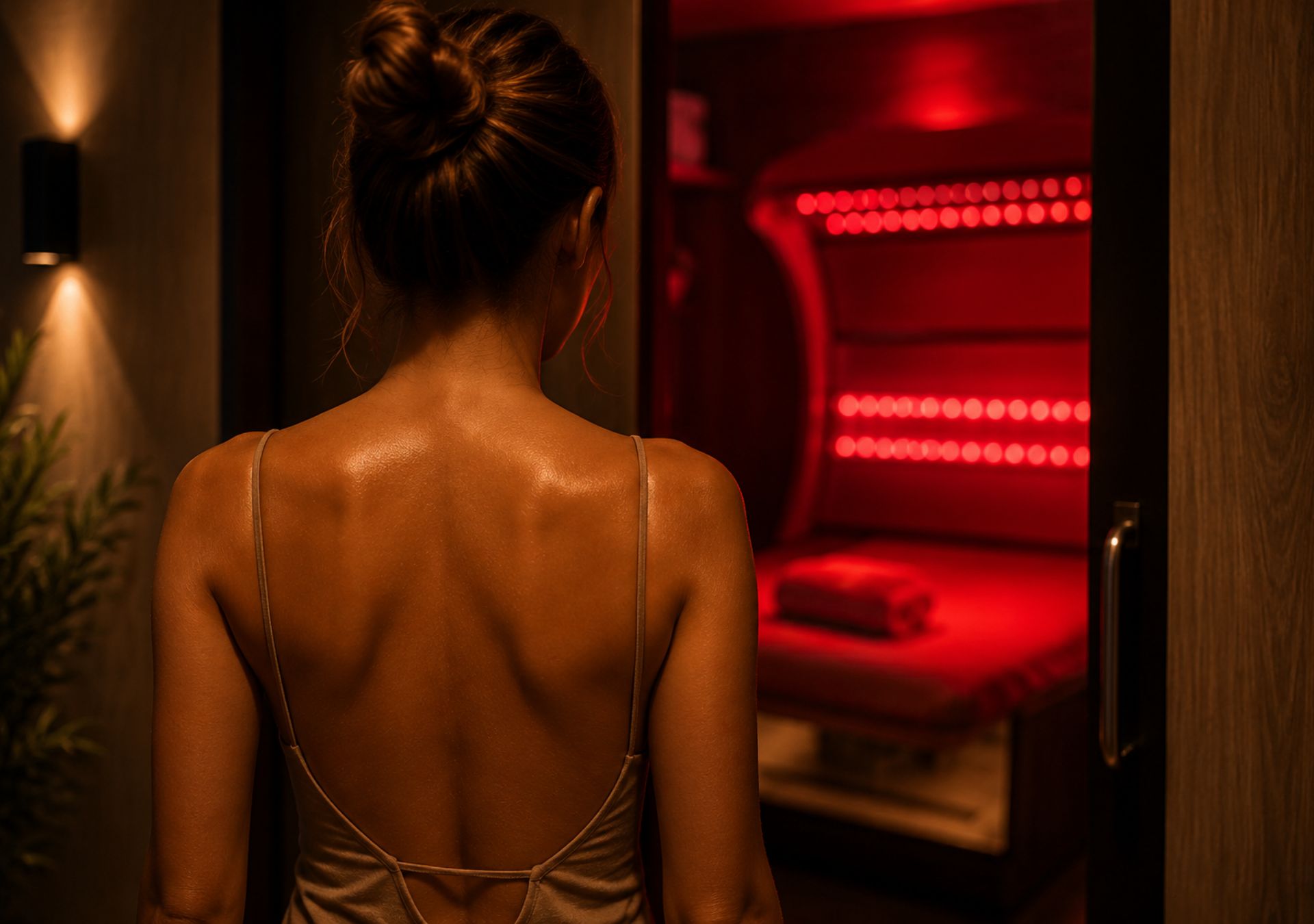
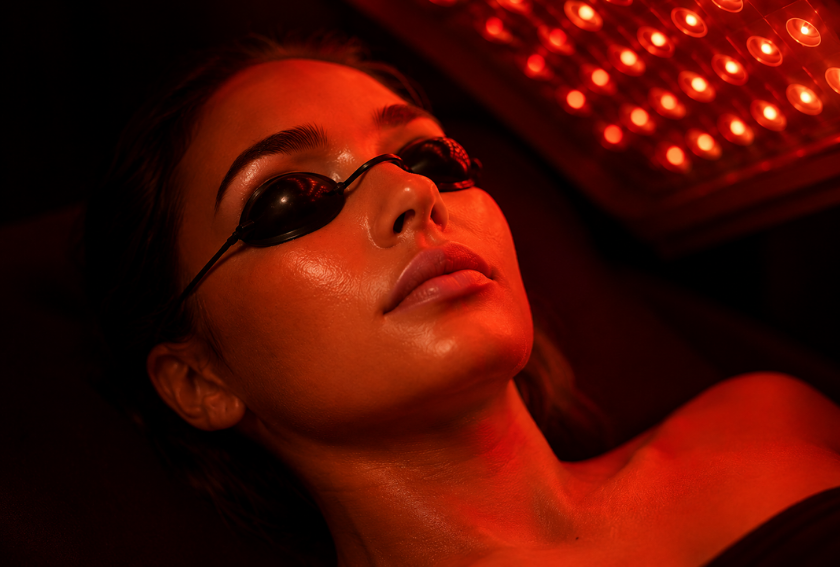
Red light is visible. It’s responsible for the distinctive red glow you see during a session.
Near-infrared light (NIR) sits just beyond visible red light on the electromagnetic spectrum. You can’t see it in the same way, and its longer wavelengths generally penetrate tissue more deeply than visible red light. Neither is UV, and neither produces a UV tan.
Red light vs near-infrared at a glance

Does red light tan you?
No. Red light therapy doesn’t give you a UV tan.
A tan is the skin’s response to ultraviolet radiation. A dedicated red and near-infrared session doesn’t use UVA or UVB, so it doesn’t work in the same way.
This is where terms such as “red light tanning” and “red light sunbed” can be confusing. A modern bed can contain both UV tanning and red light technology, but that doesn’t mean they’re the same thing or that they’re always operating together.
Our K11 Air Plus is a good example. It can provide a UV tanning session, but it can also run dedicated UV-free LightCare programmes. So it’s the same bed, but different light technology and a completely standalone non-UV experience.
Is red light therapy the same as a sunbed?
Not necessarily. A conventional sunbed uses UV light to produce a cosmetic tan. A dedicated red light therapy bed uses red and/or near-infrared light without UV.
Some newer equipment combines several light technologies in one bed. That’s why it’s more useful to ask which programme and light technology you’re using than simply whether the equipment looks like a sunbed.
At The Tan Station, our megaSun K11 Air Plus can switch between its tanning functions and dedicated non-UV LightCare programmes, with the two experiences clearly separate.
Red light therapy on the megaSun K11 Air Plus
This brings us to the technology available at The Tan Station.
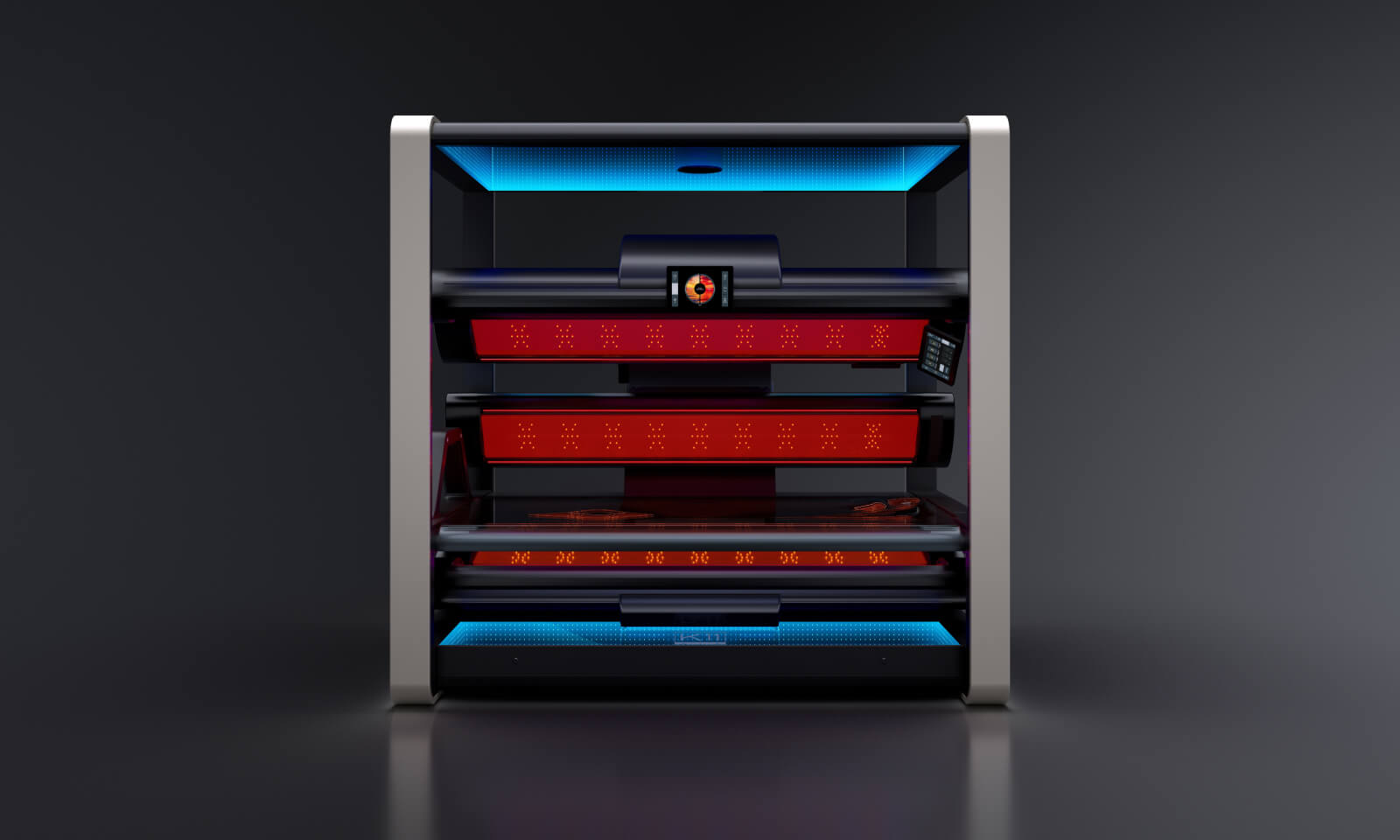
The megaSun K11 Air Plus doesn’t simply use red-coloured lighting to change the appearance of a tanning bed. It incorporates dedicated red and infrared LED technology that enables its separate UV-free LightCare programmes.
According to megaSun’s K11 specification, the bed incorporates:
- 552 Redlight LEDs
- 180 Infrared LEDs
- 4,800+ Nano Beauty LEDs
For a dedicated non-UV LightCare session, you can choose from two programmes: Beauty Light and Energizing Light.
Beauty Light
Beauty Light combines visible red light with gentle near-infrared light, with greater emphasis on the red-light side of the spectrum. megaSun positions Beauty Light around skin appearance and describes it as the softer of the two LightCare experiences. The key thing to know as a customer is that it’s a dedicated UV-free programme that doesn’t tan your skin.
Energizing Light
Energizing Light changes the balance of the light being delivered. This programme places greater emphasis on near-infrared light alongside visible red light. This creates a different experience. megaSun positions it as the more warmth- and relaxation-focused of the two LightCare experiences. Again, there’s no UV and no tanning involved.
Beauty Light or Energizing Light?
Think of the choice like this:
Beauty Light places greater emphasis on visible red light and a skincare-focused LightCare experience.
Energizing Light places greater emphasis on near-infrared and offers a warmth- and relaxation-focused LightCare experience.
Both programmes use red and near-infrared light. The balance between them is what changes.
If you’re not sure which one to choose, speak to us about your goals, and we’ll talk you through the difference.
What are Nano Beauty LEDs?
There’s another type of LED technology inside the K11 that’s worth explaining, because it’s easy to confuse it with LightCare.
Alongside its dedicated Redlight and Infrared LEDs, the K11 contains more than 4,800 Nano Beauty LEDs within its regular tanning configuration, which aren’t the same as booking a standalone LightCare session.
During a normal K11 tanning session, Nano Beauty LEDs form part of the overall tanning experience alongside the bed’s UV technology. LightCare is different. It uses the K11’s dedicated red and infrared systems to provide a completely UV-free session.
Put simply:
- K11 tanning session: UV tanning technology + Nano Beauty LEDs.
- K11 LightCare session: dedicated red + near-infrared light without UV.
If you’re specifically looking for a non-UV red light session, choose one of the dedicated LightCare programmes: Energizing or Beauty Light mode.
Can you combine red light therapy and tanning?
Red light and UV tanning are different technologies, and the K11 has been designed to offer both experiences.
Its Nano Beauty LEDs are incorporated into its regular tanning experience, while Beauty Light and Energizing Light provide dedicated non-UV LightCare programmes. You don’t have to tan to use LightCare. If you’re only interested in a non-UV session, that’s absolutely fine.
And if you’re unsure about what you’re booking, ask the team before you start. We’ll explain which programme you’re using and whether or not it includes UV.
What does a red light therapy session feel like?
If you’ve only ever experienced a conventional sunbed, LightCare is a different experience.
You’ll see the distinctive glow produced by the visible red LEDs, while near-infrared light operates beyond the visible spectrum. The experience differs depending on the programme you choose. Beauty Light puts more emphasis on visible red light, while Energizing Light focuses more on near-infrared and warmth. Both offer a standalone non-UV session on our flagship megaSun’s K11 Air Plus.
Your session takes place in a private K11 Glow Bay, and our team can explain the programmes before your first visit.
Red light therapy FAQs
Dedicated red light therapy doesn’t use ultraviolet light. The K11 Beauty Light and Energizing Light programmes available on the K11 Air Plus at The Tan Station are completely UV-free.
Does red light therapy give you a tan?
No. Red and near-infrared light don’t produce the tanning response caused by UV. If you’re using the K11 in LightCare mode, you’re not having a UV tanning session.
Is infrared the same as red light?
No. Visible red and near-infrared occupy different parts of the electromagnetic spectrum. Red light can be seen, while near-infrared sits beyond visible red and generally penetrates tissue more deeply.
What’s the difference between red light therapy and a red light sunbed?
“Red light sunbed” is an informal term that can describe different equipment. Some beds provide non-UV red light only, while advanced equipment such as the K11 Air Plus can provide both UV tanning and separate non-UV red and near-infrared programmes. Always check which programme you’re actually using.
What’s the difference between Beauty Light and Energizing Light?
Both are UV-free LightCare programmes on the K11. Beauty Light places greater emphasis on visible red light and skin appearance. Energizing Light places greater emphasis on near-infrared and is positioned more around warmth and relaxation.
Nano Beauty LEDs are incorporated into the K11’s regular tanning configuration. LightCare uses dedicated red and infrared technology to provide standalone Beauty Light and Energizing Light programmes without UV.
Yes. You don’t need to have a tanning session to use LightCare. Beauty Light and Energizing Light are available as standalone non-UV programmes.
Can I try red light therapy if I’ve never used a sunbed?
Yes. You don’t need to be a tanning customer to choose a standalone LightCare session.
Tell our team it’s your first time and we’ll explain the K11 Air Plus, your programme and what to expect before you start.
Where can I try red light therapy in Chesterfield?
The Tan Station offers dedicated non-UV LightCare sessions on the megaSun K11 Air Plus at our studio in Brimington, Chesterfield.
Disclaimer
The Tan Station’s LightCare sessions are offered for cosmetic and wellness use only. They are not medical treatments and are not intended to diagnose, treat, cure or prevent any medical or skin condition. Eye protection must be worn during all sessions. If you are unsure whether red light is suitable for you, or if you are taking any photosensitising medication, please consult your GP before booking and advise our team.